Freeze Drying Process Steps Explained Clearly, When we think of innovative methods that can extend the shelf life of food and pharmaceuticals, we often look towards futuristic technologies. However, what if an age-old principle — the very essence of winter itself — held the secret to advanced preservation?
This is the realm of the freeze-drying process, a sophisticated form of lyophilization that has been continuously perfected over time. By delving into the intricacies of freeze drying techniques and freeze drying protocol, we unearth the fascinating journey from fresh to freeze-dried, ensuring longevity and quality.
Just like preserving the delicate form of a snowflake away from the warmth that would melt it, freeze-drying delicately handles perishable materials to maintain their structure and nutrition. Join us as we explore each meticulously tuned step of the freeze-drying process and uncover how this extraordinary method is revolutionizing the way we store and transport crucial goods across the globe.
Key Takeaways
- Understanding the fundamentals of the freeze-drying process and its ability to preserve material integrity.
- Exploring state-of-the-art freeze drying techniques for optimizing product longevity.
- Diving into the rigorous freeze-drying protocol that ensures the high-quality transition from liquid to vapor.
- Discovering the role of precise temperature and pressure settings in maintaining product composition.
- Realizing the importance of the freeze-drying stages in retaining the original attributes of the material.
- Learning why meticulous control in freeze-drying equipment can be the difference between success and spoilage.
The Significance of Understanding the Freeze-Drying Process
For those involved in the complex world of lyophilization, a deep dive into the freeze-drying process steps can significantly further one’s grasp on creating exceptional product quality. It’s not just about preserving materials; it’s about perfecting a process that hinges on precise execution at each stage. Our commitment to understanding freeze-drying stages is the foundation that supports the impeccable structural integrity and viability required for the long-term potency of products.

Let’s say we’re tackling the lyophilization process. Knowing just the basics is not enough; instead, mastering each phase and its critical factors—such as control over the freezing rate, temperature, pressure, and phase duration—is what differentiates an average result from an extraordinary one.
✅ For a foundational overview, read:
General Principles of Freeze Drying – The Lyophilization Process
Below, we’ve put together an essential guide that outlines these factors, providing an invaluable resource for those looking to refine their technique and optimize outcomes.
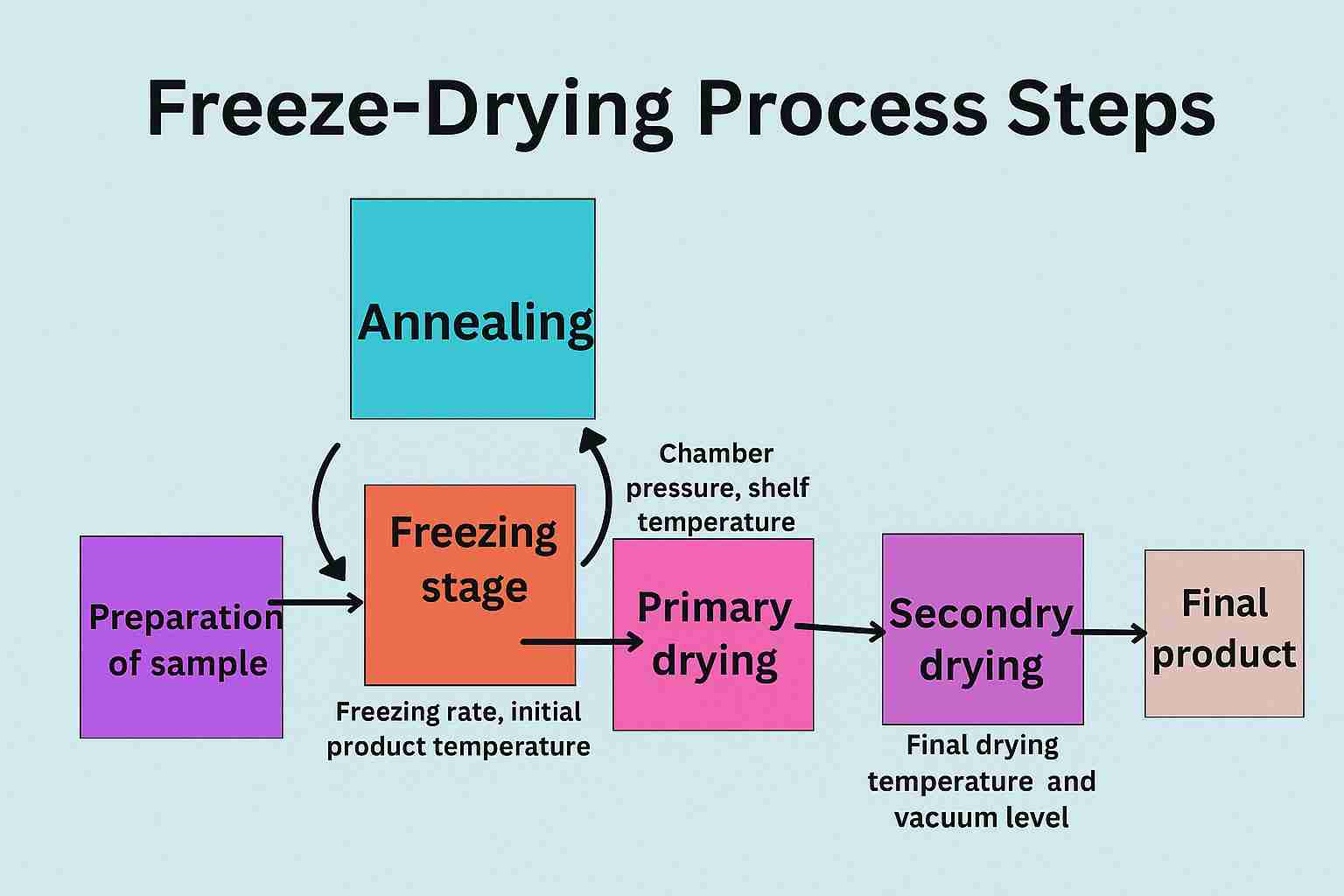
| Freeze-Drying Stage | Key Parameters | Impact on Product Quality |
|---|---|---|
| 1. Freezing Phase | Freezing rate, initial product temperature | Critical for determining crystal size and product structure |
| 2. Primary Drying (Sublimation) | Chamber pressure, shelf temperature | Handles the bulk of moisture removal and influences drying time |
| 3. Secondary Drying (Adsorption) | Final drying temperature and vacuum level | Completes moisture removal and locks in product stability |
By aligning ourselves with the intricacies of the freeze drying process steps and allowing data-driven insights to guide us, we find that not only does the end product shine, but we also streamline energy use and reduce overall costs—a triumph for both the manufacturer and the consumer. Indeed, walking through the freeze-drying stages with a discerning eye can lead to breakthroughs in both science and industry, challenging us to push past conventional boundaries towards mastery and innovation. Here is the schematic freeze-drying process flow chart given below
Freeze drying process check and precautions before starting lyophilization cycle
- Ensure cleaning of the freeze dryer and validity of cleaning operation before use.
- check chamber surface visually for absence of moisture or foreign particles in the chamber from the view glass
- Ensure the leak test (or unit test) of freeze dryer passes before use or the start of freeze dryer cycle
Freeze-Drying Process Flow Chart and Pre-Cycle Checks
Before starting the cycle, it’s crucial to follow preparation protocols:
- Ensure cleaning validation of freeze dryer is complete.
- Confirm leak test is passed.
- Check vacuum pump oil level, pressure gauges, and utility supplies.
- Verify vent filters pass integrity tests.
- Confirm all freeze-dryer process parameters align with the approved BMR.
Ensure all the utility are provided
Ensure all the utility are provided as mentioned below
- Compressed aiR NLT: 0.4 MPa
- Chilled water NLT: 1.0 kg/cm2
- Nitrogen NLT: 0.3 MPa
- Check air pressure
- Vacuum pump oillevel
- Ensure that the vent filter on the sterile area side is placed and that the same has passed filter integrity test
All the parameter of freeze dryer process recipe are as per approved recipe or as per BMR (Batch manufacturing record of the product).
Ensure the loading hight is selected as per vials size which is to be loaded, Exampleper vials 2ml,5ml, 100ml, 15ml, 20ml, 30ml, 50ml and 10ml vials.
Preparation and Pretreatment Before Freeze Drying
Before we dive into the complexities of the freeze drying procedure, it’s imperative to understand that careful preparation and pretreatment of the product are foundational steps towards achieving optimal freeze drying results. By tweaking concentration and formulation or altering the physical attributes of the material, we can significantly affect the drying efficiency and the quality of the final product.
The success of freeze drying begins before the freezing cycle starts. Adjusting the formulation and concentration of products enhances their stability, a key topic detailed in:
We also recommend controlling surface area for improved sublimation, and ensuring that freezing rates are appropriately managed to reduce variability
Concentration and Formulation Adjustments
To prepare our products for the freeze-drying process, we often need to make adjustments to their concentration and formulation. This isn’t just about achieving a balance in the mixture; it’s about enhancing the product’s stability, preserving its appearance, and ensuring that the freeze-drying parameters are optimized for processing performance. For instance, the addition of certain stabilizers can maintain the integrity of complex structures during the drying stage.
The Role of Surface Area Enhancement
Moreover, we recognize that one of the key freeze drying parameters, surface area, plays a vital role in enhancing the efficiency of both sublimation and adsorption phases. Implementing strategies to expand the surface area, such as by creating foam or increasing porosity, can be a game-changer in expediting the overall freeze drying procedure.

| Pretreatment Step | Purpose | Impact on Freeze Drying |
|---|---|---|
| Concentration Adjustments | Stabilize product composition | Optimizes sublimation rates by ensuring a solid structure |
| Formulation Adjustments | Increase stability and appearance | Enhances the quality and shelf-life of the dried product |
| Control of Freezing Rates | Modulate ice crystal size | Improves drying efficiency for sensitive products |
| Surface Area Enhancement | Facilitate sublimation and adsorption | Accelerates drying time, improving energy efficiency |
We always aim for excellence in our freeze-drying endeavors. This means not only investing in the best freeze drying equipment but also immersing ourselves in a thorough understanding of the myriad freeze drying parameters that govern this intricate process. Emphasizing preparation and pretreatment steps enables us to refine our approach, ensuring that every product is given the attention to detail it deserves.
Freezing: The Bedrock of Effective Freeze Drying
As we delve into the foundational role of freezing in freeze drying techniques, it becomes apparent that the integrity of the lyophilization process is pivotal for quality results. This phase is not just a step; it’s the cornerstone that determines the efficiency of the entire freeze-drying process. We understand that each product demands a tailored approach to freezing, accounting for its unique properties to ensure the perfect balance between structure preservation and moisture removal.
The freezing phase sets the tone for the rest of the process. Ice crystal size, determined here, influences drying time and product structure. For biopharma, correct freezing is vital.
🧊 Learn more: Lyophilization Temperature Guidelines
🧪 Monitor freezing accurately with: Pre-Study Qualification of Thermocouples
Methods for Controlling Ice Crystal Formation
The size of ice crystals formed during the freezing phase is critical, setting the stage for the subsequent drying cycles. Here, we employ specific techniques to moderate ice nucleus generation and crystal growth. One such method is annealing, which involves a controlled temperature rise post-freezing. This tactic targets the perfection of larger ice crystals to enhance the subtleties of the sublimation process. However, we approach materials of biological significance with caution, as our priority is to prevent any cellular disruption.
Ensuring Sublimation Over Melting
To guarantee that sublimation takes precedence over melting, rapid freezing is instrumental, particularly for materials sensitive to structural anomalies. By quickly lowering products to temperatures as low as −50 °C to −80 °C, we lower the chance of large crystals forming, which is an important thing to think about if you want to keep the product’s nutritional value and texture.
| Freezing Technique | Ice Crystal Size | Impact on Sublimation | Suitability |
|---|---|---|---|
| Slow Freezing | Larger | Eases sublimation rate | Suitable for robust materials |
| Rapid Freezing | Smaller | Prevents melting | Preferred for sensitive products |
| Annealing | Controlled and larger | Facilitates faster sublimation | Optimal for complex structures |
In laying out these freeze-drying process steps, our primary goal is to fine-tune the balance between speed and temperature to favor sublimation. We meticulously monitor these elements, always striving to achieve the ultimate quality in every batch. Understanding and harnessing the capabilities of freeze-drying techniques is not just our commitment; it’s our craft.
Primary Drying: The Sublimation Stage
In our exploration of the freeze-drying cycle, we arrive at a pivotal juncture known as the primary drying phase. This is the stage where meticulous control can make or break the integrity of our product. Sublimation—the transition of ice directly to vapor—is the hero of this process, whisking away moisture under conditions that would make a tightrope walker envious of its balance. We understand the gravity of this phase and respect the demands it places on precisely calibrated freeze-drying parameters. This critical phase removes up to 95% of moisture. It requires precise control of vacuum and heat. Read more about its significance in:
Also, understand dry layer resistance and its impact on heat transfer efficiency.
Secondary Drying (Desorption Phase)
This final drying stage ensures removal of bound moisture and stabilizes the product.
🧴 Refer to: Freeze Dryer Shelf Heating and Cooling Rate Verification
Troubleshooting and Quality Assurance
Even with precision, failures can occur. Common issues include:
- Compressor excess temperature
- Alarm due to condenser cooling failure
- Pressure deviations or nitrogen venting
- Failure in silicon oil heating or circulation
📋 For full coverage, refer to:
Freeze Dryer Troubleshooting Guide
The Critical Balance of Pressure and Temperature
Imagine a symphony where pressure and temperature are principal instruments. Their harmony dictates the success of the freeze-drying stages, with each parameter playing an integral role. We don’t just set and forget; we carefully dial in the vacuum pressure to avoid collapse and modulate heat to ensure energy is efficiently transferred to our product without compromising its structure. This balance isn’t serendipity; it’s the result of our relentless pursuit of perfection.
Monitoring Sublimation for Optimal Results
Why do we monitor the sublimation process with such precision? The answer is simple: to safeguard the quality that our customers expect. The journey from ice to vapor within the freeze-drying cycle requires constant vigilance. We watch intently, adjust slightly, and nurture persistently, ensuring that the product’s transformation is not rushed or hindered. With about 95% of water content making its exit in this act, our dedication during these several days culminates in a performance worthy of a standing ovation—had there been an audience in our lab!
Conclusion of Freeze Drying Process Steps
The freeze-drying process is a combination of science, technology, and precision. From preparation to final inspection, each step influences product quality, shelf-life, and cost-effectiveness.
For deeper insights, explore our guides on:
- Freeze Dryer Process Flow Chart
- Understanding Dose Variation in Freeze-Dried Pharmaceuticals
- Lyophilizer Qualification Guidelines
FAQ releted Freeze Drying Process Steps
What are the main steps in the freeze-drying process?
The freeze-drying process comprises three main steps: first, the freezing stage, where the material is solidified; second, the primary drying phase, known as sublimation, where most of the water is removed under low pressure and heat; and finally, the secondary drying stage, or adsorption, where any remaining moisture is eliminated, completing the process.
Why is it important to understand the freeze-drying process?
Understanding the freeze-drying process is crucial to achieving the desired quality of the end product while maintaining efficiency. Understanding each lyophilization stage allows for better control over critical parameters such as temperature and pressure, which can affect the texture, structure, and stability of the product. This knowledge is vital for designing effective freeze-drying cycles and equipment, ultimately improving product shelf life and reducing costs.
How do concentration and formulation adjustments affect freeze-drying?
Before the freeze-drying procedure begins, adjustments to the product’s concentration and formulation play a significant role. These modifications can aid in increasing the stability of the product, preserving its appearance, and enhancing the overall efficiency of the process. For example, adding certain substances can help protect the structure during the drying process and improve the rehydration qualities afterward.
How does the method of freezing influence the quality of the end product?
The freezing method is pivotal in determining the size and shape of ice crystals, which significantly impacts the final product’s quality. Slow freezing or annealing promotes the formation of larger ice crystals, which can ease the sublimation process. Conversely, rapid freezing is employed to protect delicate structures and maintain the material’s integrity during sublimation.
How can we enhance the surface area for effective freeze drying?
Enhancing the product’s surface area is a technique used to accelerate the sublimation and adsorption processes in freeze drying. Increasing the product’s porosity or using particulate materials can accomplish this, allowing water vapor to escape more quickly and cutting down on the drying time.
What methods are used to control ice crystal formation during freezing?
To control the formation of ice crystals, we can use various freezing techniques. Slow freezing results in larger crystals, while rapid freezing leads to smaller ice formations. Specialized freeze drying equipment may also utilize annealing, where temperatures are cycled to control the crystal size. The chosen method typically depends on the specific requirements of the product being lyophilized.
Why is it crucial to ensure sublimation over melting in freeze-drying?
Ensuring sublimation rather than melting is crucial because it preserves the material’s physical form and integrity. This process maintains the structure, nutritional value, and flavor of the product. By controlling the freeze-drying parameters such as temperature and pressure, we can guarantee that the ice transitions directly to vapor without passing through a liquid phase, which could damage the product.
What is the critical balance of pressure and temperature during the primary drying phase?
During primary drying, it is essential to maintain a critical balance of reduced pressure and controlled heating. This balance ensures efficient removal of water by sublimation without compromising the structural integrity of the product. The aim is to apply enough heat to facilitate sublimation, but not so much that it could potentially alter the product’s structure.
How do we monitor sublimation to achieve optimal results?
Monitoring sublimation involves closely tracking the temperature, pressure, and time during the primary drying stage. We use sensors and control systems built into the freeze drying equipment to make real-time adjustments, ensuring that the sublimation occurs at the ideal rate. By optimizing these parameters, we prevent potential damage to the product and achieve a high-quality result.