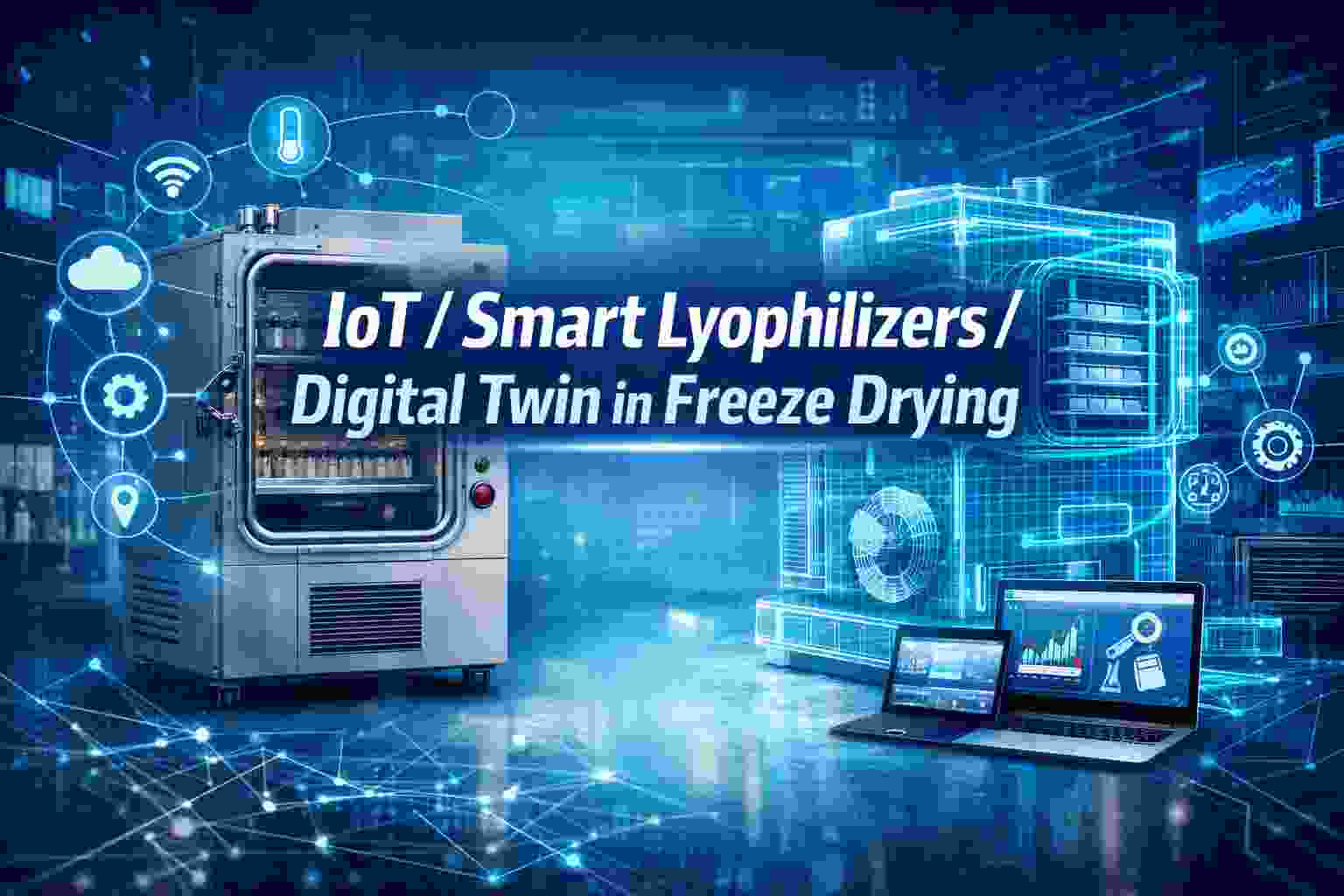
IoT / Smart Lyophilizers / Digital Twin: The Future of Intelligent Freeze Drying
IoT / Smart Lyophilizers / Digital Twin technologies are rapidly redefining how modern freeze-drying systems are designed, monitored, and optimized. As pharmaceutical, biotechnology, and food manufacturers push for higher efficiency, sustainability, and regulatory compliance, traditional freeze-drying approaches are no longer sufficient.
Today’s facilities demand energy-efficient lyophilization, real-time analytics, and intelligent automation to reduce operational costs and environmental impact. Advanced concepts such as Lyophilization 4.0 smart freeze drying and PAT in freeze drying now enable continuous process verification, predictive control, and data-driven decision-making throughout the lyophilization lifecycle.
This article explores how IoT, smart lyophilizers, and digital twin technology are transforming lyophilization, covering benefits, challenges, implementation strategies, and future trends.
Understanding IoT / Smart Lyophilizers / Digital Twin Technology
What Is IoT in Lyophilization?
The Internet of Things (IoT) refers to a network of interconnected devices that collect, transmit, and analyze data in real time. In lyophilization, IoT integrates sensors, controllers, cloud platforms, and analytics software into freeze dryers.
IoT-enabled freeze dryers integrate smart sensors, software platforms, and cloud connectivity to collect and analyze process data in real time. Technologies such as NIR spectroscopy in lyophilization play a crucial role by enabling non-invasive moisture and endpoint detection during primary and secondary drying.
In parallel, AI-powered platforms support smarter control and defect prevention, allowing manufacturers to identify deviations early and maintain consistent product quality across batches.
As a result, critical parameters such as:
- Shelf temperature
- Product temperature
- Chamber pressure
- Condenser performance
- Moisture content
are continuously monitored and analyzed.
What Are Smart Lyophilizers?
Smart lyophilizers are next-generation freeze dryers equipped with:
- Advanced sensors
- Automated control algorithms
- Process Analytical Technology (PAT)
- Remote monitoring capabilities
Unlike conventional systems, smart lyophilizers can adjust cycle parameters automatically based on real-time feedback. Therefore, they reduce human error and improve batch consistency.
What Is a Digital Twin in Lyophilization?
A digital twin is a virtual replica of a physical freeze-drying system. It uses real-time data, mathematical models, and historical batch data to simulate and predict process behavior.
In lyophilization, digital twins allow engineers to:
- Simulate freeze-drying cycles
- Predict product temperature and moisture profiles
- Optimize cycle parameters before production
According to the FDA’s PAT guidance, digital models play a key role in improving process understanding and control (see FDA PAT framework via Google).
Why IoT/Smart Lyophilizers/Digital Twin Matter in Modern Freeze Drying
One major driver for smart lyophilization adoption is sustainability. Modern facilities increasingly focus on green freeze drying technology to minimize energy usage, reduce carbon emissions, and comply with global sustainability goals.
Additionally, manufacturers leverage data-driven optimization to improve lyophilization process efficiency, reducing cycle time without compromising critical quality attributes
Increasing Regulatory Pressure
Regulatory agencies emphasize:
- Quality by Design (QbD)
- Process Analytical Technology (PAT)
- Continuous process verification
Therefore, digital solutions are no longer optional. IoT-enabled freeze dryers support data integrity, traceability, and compliance.
Growing Need for Efficiency
Freeze drying is energy-intensive and time-consuming. However, smart systems:
- Reduce cycle time
- Minimize energy consumption
- Lower batch failures
Consequently, manufacturers gain a significant competitive advantage.
Key Components of IoT / Smart Lyophilizers / Digital Twin Systems
A smart lyophilizer is built on a solid mechanical and thermal foundation. Understanding the construction of a freeze dryer is essential for implementing digital upgrades successfully. Components such as shelves, condensers, vacuum systems, and control valves must support precise automation.
Equally important are heating media control in lyophilization and cooling water regulation in freeze dryers, as both directly affect heat transfer efficiency, drying uniformity, and energy consumption.
Advanced Sensors and Instrumentation
Smart lyophilizers rely on:
- Wireless temperature probes
- Pirani and capacitance manometers
- Moisture and mass spectrometry sensors
These devices feed continuous data into the system.
Cloud Connectivity and Data Platforms
IoT platforms store and analyze process data securely. As a result:
- Engineers can monitor cycles remotely
- Historical data supports trend analysis
- Predictive maintenance becomes possible
Artificial Intelligence and Machine Learning
AI-driven algorithms:
- Identify anomalies
- Predict endpoint detection
- Recommend cycle adjustments
Therefore, decision-making becomes faster and more accurate.
Digital Twin Modeling Software
Digital twin platforms integrate:
- Heat and mass transfer models
- Product formulation data
- Equipment-specific parameters
This allows realistic simulation of real-world freeze-drying behavior.
Benefits of IoT / Smart Lyophilizers / Digital Twin Technology
Real-Time Process Visibility
Operators gain complete transparency across all stages of lyophilization. Consequently, deviations are detected immediately.
Faster Cycle Development
Digital twins eliminate trial-and-error experimentation. Instead, engineers simulate multiple cycles virtually, saving time and materials.
Improved Product Quality
Smart lyophilizers significantly reduce common product defects. Continuous monitoring helps identify risks related to vial appearance defects in lyophilization, including shrinkage, cracks, or discoloration.
Predictive models also help prevent meltback defects in lyophilized cake, while comprehensive analytics support accurate defect classification in lyophilized products, improving batch release confidence.
Smart control prevents:
- Collapse
- Melt-back
- Over-drying
As a result, product stability and shelf life improve.
Reduced Operational Costs
Automation lowers labor dependency and energy usage. Predictive maintenance also prevents costly downtime.
Enhanced Regulatory Compliance
Regulatory compliance remains a top priority. Smart systems simplify adherence to GMP requirements for freeze drying by ensuring traceable data, audit-ready documentation, and consistent process execution.
Digital tools also streamline lyophilizer qualification guidelines and support long-term compliance through lyophilization validation best practices, especially for commercial manufacturing environments.
Continuous data logging ensures:
- Audit readiness
- Data integrity
- Process traceability
Challenges in Implementing IoT / Smart Lyophilizers / Digital Twin
High Initial Investment
Advanced hardware, software, and training require capital investment. However, long-term savings often outweigh upfront costs.
Data Integration Complexity
Legacy equipment may not support IoT connectivity. Therefore, system upgrades or retrofitting may be required.
Cybersecurity Risks
Connected systems must be protected against data breaches. Secure cloud platforms and encryption are essential.
Model Validation and Accuracy
Digital twins must be validated carefully to ensure predictions match real-world behavior.
Role of PAT in IoT / Smart Lyophilizers / Digital Twin Systems
Process Analytical Technology (PAT) forms the backbone of digital lyophilization. Advanced control strategies such as robust control in lyophilization enable dynamic adjustment of temperature and pressure based on real-time feedback.
Digital twins also support advanced lyophilization process monitoring alarms, ensuring early detection of abnormal conditions and preventing costly batch failures.
Process Analytical Technology (PAT) enables:
- Real-time measurement of critical quality attributes
- In-line and at-line monitoring
- Feedback-based control
IoT platforms integrate PAT tools seamlessly, supporting FDA and EMA expectations.
For regulatory context, refer to FDA PAT guidance available on this source.
Applications of Digital Twins in Lyophilization
Digital twin technology is especially valuable in advanced pharmaceutical applications. For example, freeze drying for cell and gene therapy products requires extremely tight control due to sensitivity to temperature and moisture variations.
Similarly, digital twins support biopharmaceutical freeze-drying applications and specialized formulations such as lyophilization in veterinary drugs, where consistency and stability are critical for therapeutic effectiveness
Cycle Optimization
Digital twins help optimize:
- Freezing rate
- Primary drying temperature
- Secondary drying duration
Scale-Up and Tech Transfer
Virtual simulations reduce scale-up risks when moving from lab to production.
Continuous Improvement
Historical data improves future cycle performance through iterative learning.
Future Trends in IoT / Smart Lyophilizers / Digital Twin Technology
The future of freeze drying extends beyond automation. Emerging technologies such as blockchain in lyophilization supply chains will improve data transparency, traceability, and product authenticity.
At the same time, continuous freeze-drying processes combined with real-time digital twins will redefine manufacturing efficiency and scalability.
- AI-Driven Autonomous Freeze Dryers: Future systems will self-adjust without human intervention.
- Integration with MES and ERP Systems: Smart lyophilizers will connect directly with manufacturing execution systems.
- Real-Time Digital Twins: Live digital twins will update continuously during production.
Sustainability and Energy Optimization: Smart control will significantly reduce carbon footprint.
Why Manufacturers Are Adopting Smart Lyophilizers Faster Than Ever
- Increased batch complexity
- Shorter product life cycles
- Rising compliance demands
Therefore, smart lyophilization is becoming an industry standard.
Conclusion
IoT / Smart Lyophilizers / Digital Twin technologies represent a fundamental shift in freeze-drying science. By combining real-time monitoring, predictive analytics, PAT, and virtual modeling, manufacturers achieve unprecedented control, efficiency, and compliance.
As digital transformation accelerates, companies that invest early in smart lyophilization will lead the future of pharmaceutical and industrial freeze drying.
FAQs: IoT / Smart Lyophilizers / Digital Twin
1. What is IoT in lyophilization?
IoT connects sensors and software to monitor freeze-drying parameters in real time.
2. How do smart lyophilizers improve product quality?
They adjust process parameters automatically to prevent defects.
3. What is a digital twin in freeze drying?
It is a virtual model that simulates and predicts lyophilization behavior.
4. Are digital twins accepted by regulatory agencies?
Yes, when properly validated, they support PAT and QbD frameworks.
5. Can IoT reduce freeze-drying cycle time?
Yes, real-time feedback enables faster and safer optimization.
6. Is retrofitting old freeze dryers possible?
Yes, many systems can be upgraded with sensors and IoT modules.
7. How secure are IoT-enabled lyophilizers?
With encryption and access control, data security is highly robust.
8. Do smart lyophilizers reduce energy consumption?
Yes, optimized cycles significantly lower energy usage.
9. What industries benefit most from digital twins?
Pharmaceutical, biotech, diagnostics, and food industries.
10. Are smart lyophilizers the future of freeze drying?
Yes, they are rapidly becoming the industry standard.