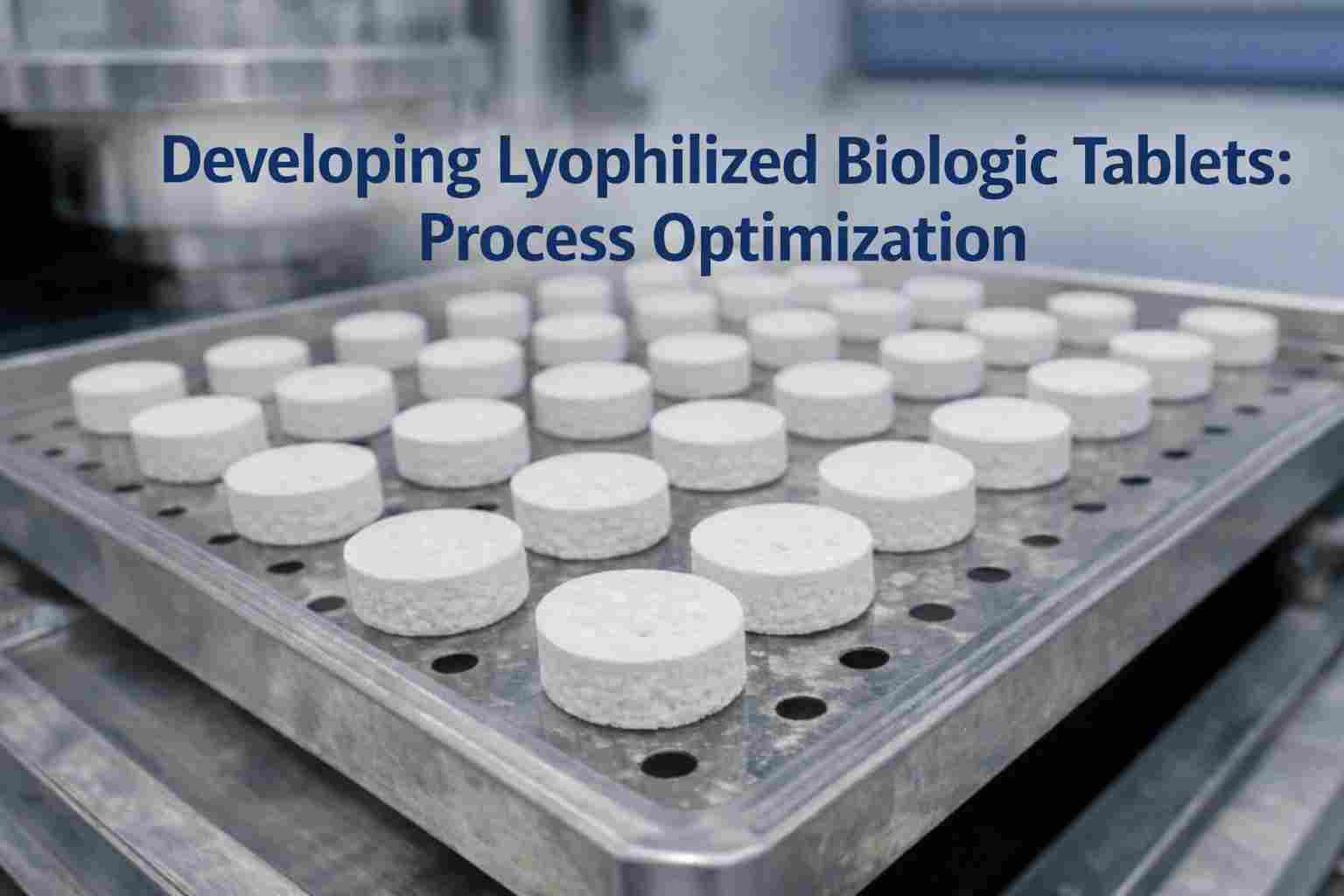
Developing Lyophilized Biologic Tablets: Process Optimization — Benefits & Challenges of Lyophilized Orally Disintegrating Tablets
Developing Lyophilized Biologic Tablets: Process Optimization is a comprehensive approach central to modern pharmaceutical manufacturing. This process focuses on producing lyophilized (freeze-dried) biologic tablets, particularly orally disintegrating tablets, with enhanced stability, patient compliance, and therapeutic efficacy.
In today’s pharmaceutical environment, where biologic medicines such as peptides, vaccines, and sensitive proteins are increasingly common, optimizing freeze-drying is crucial for ensuring product quality and performance.
Lyophilized tablets are widely used because they improve shelf life, stability against degradation, and ease of storage. Yet, there are both benefits and challenges associated with lyophilized orally disintegrating tablets. This detailed article explains the complete process from formulation to optimization, highlights key advantages, addresses technical challenges, and offers practical solutions backed by research and industry best practices.
What Are Lyophilized Biologic Tablets?
Lyophilized biologic tablets are solid dosage forms containing sensitive biologic drugs that have been freeze-dried (lyophilized) to preserve their structure, activity, and longevity. This process removes water under low temperature and vacuum, converting a liquid or semi-solid formulation into a highly porous, dry tablet.
Why Choose Lyophilization for Biologic Tablets?
Lyophilization helps maintain:
- Biologic stability — preventing denaturation
- Chemical integrity — reducing degradation
- Enhanced shelf life — even at ambient temperatures
- Improved patient compliance — if designed as orally disintegrating tablets (ODTs)
For best outcomes, pharmaceutical companies rely on advanced freeze dryer technologies and carefully optimized process parameters — such as those available through https://asitafreezedryer.com/.
Fundamentals of Developing Lyophilized Biologic Tablets: Process Optimization
Optimizing lyophilization requires an integrated process approach that includes:
1. Pre-Formulation Analysis
Pre-formulation is the foundation of optimization. It involves understanding the physicochemical properties of the biologic drug, excipients, and formulation behavior under freezing conditions.
Critical considerations include:
- Protein stability
- Glass transition temperature (Tg)
- Cryoprotectants and stabilizers
- Desired disintegration time
2. Formulation Development
Formulators must choose excipients that protect the drug during freezing and drying. Common excipients include:
- Sugars (e.g., trehalose, sucrose) to stabilize proteins
- Polymers (e.g., PVP, HPMC) to support structure
- Bulking agents (e.g., mannitol) for physical integrity
Careful balancing ensures quick disintegration while maintaining tablet strength.
3. Freezing Optimization
Freezing is one of the most critical stages. Rapid or slow freezing affects ice crystal development, which influences pore structure and drying efficiency. Controlled freezing strategies enhance:
- Drying rate
- Porosity and mechanical strength
- Residual moisture control
Software-guided and shelf temperature profiling help manage this complex stage.
4. Primary Drying (Sublimation)
This step removes ice through sublimation under vacuum. Optimizing shelf temperature and chamber pressure prevents product collapse and ensures uniform drying.
Real-time monitoring (e.g., Pirani and capacitance manometers) and controlled ramps improve uniformity and throughput.
5. Secondary Drying (Desorption)
Secondry drying process to achieve low residual moisture (<1–2%), temperature is raised slightly without harming biologic integrity. This step secures longer shelf stability and reduces degradation risk.
Benefits of Lyophilized Orally Disintegrating Tablets
Lyophilized Orally Disintegrating Tablets (ODTs) offer several advantages:
Rapid Disintegration and Ease of Use
Lyophilized ODTs dissolve quickly in the mouth without water, which is especially beneficial:
- For pediatric and geriatric patients
- In conditions with swallowing difficulties (dysphagia)
- During travel or emergency use
Enhanced Stability for Biologics
Lyophilization extends the shelf life of labile biologic molecules that would otherwise degrade in liquid form.
Benefits include:
-
Resistance to hydrolysis and oxidation
-
Reduced reliance on cold chain logistics
-
Greater flexibility in distribution
Improved Patient Compliance
ODTs enhance compliance due to:
- Pleasant mouthfeel
- Fast onset of action
- Simple administration
Patient-centric design is a key driver in biologic drug development.
Reduced Packaging and Storage Requirements
Due to their low moisture content and improved stability, lyophilized tablets often require less stringent storage conditions, cutting down cold chain costs and complexity.
Major Challenges in Developing Lyophilized Orally Disintegrating Tablets
Despite clear benefits, there are formidable challenges:
1. Formulation Complexity
Balancing mechanical strength with rapid disintegration is difficult. Formulations must be strong enough to withstand handling but porous enough to dissolve instantly.
2. Long Processing Time
Lyophilization is time-intensive. Primary drying alone can take many hours due to the need for low temperatures and vacuum conditions.
3. High Production Costs
Specialized equipment (like shelf-type freeze dryers) and energy requirements increase production costs. Justifying these costs demands premium pricing or mass scale-up strategies.
Explore freeze dryer options and solutions at https://asitafreezedryer.com/.
4. Risk of Physical Defects
Improper optimization can cause:
- Cake collapse
- Melt-back
- Cracking
All of which compromise quality.
Regulatory and Quality Control
Biologic drugs require stringent regulatory oversight. Ensuring batch-to-batch consistency and meeting compliance standards (e.g., ICH, FDA, EMA) is essential.
Best Practices in Optimizing Lyophilized Biologic Tablets
To tackle these challenges, manufacturers adopt proven strategies:
Using Design of Experiments (DoE)
Rather than trial-and-error, DoE systematically identifies the influence of key variables like:
-
Freezing rate
-
Excipient ratios
This data-driven method significantly improves success rates.
Implementation of Process Analytical Technology (PAT)
PAT tools (e.g., moisture sensors, temperature probes) enable real-time adjustments during lyophilization. These tools reduce variability and ensure consistent product quality.
Advanced Freeze Dryer Technologies
Selecting freeze dryers with:
- Uniform shelf temperature control
- Intelligent vacuum control
- Automated ramping features
…drives efficiency and lowers operational risk. Top-tier machines and services are available via https://asitafreezedryer.com/.
Predictive Modeling and Simulation
Predictive software simulation of freeze-dry cycles helps reduce experimental runs, saving time and resources while refining final protocols.
Scaling Up: From Lab to Commercial Manufacturing
Manufacturers face distinct challenges when scaling lyophilized biologic tablets:
Equipment Selection
Choosing scalable freeze dryers with consistent performance across scales (lab → pilot → commercial) enables smoother transitions.
Enhanced Quality Systems
Large-scale environments demand robust quality systems, documentation, and validation protocols that align with GMP practices.
Cost Management
Cost reduction strategies include:
- Cycle time reduction
- Bulk processing
- Energy-efficient freeze dryers
These tactics improve profitability without affecting quality.
Case Studies: Successful Lyophilized Tablet Optimization
Case Study 1: Vaccine Tablet Development
A biologics company developing a lyophilized vaccine tablet found:
- Optimized freezing improved ice crystal formation
- Secondary drying minimized residual moisture
- Product stability increased from 6 months to 2 years
Case Study 2: Peptide ODT for Pain Management
By using specific cryoprotectants and DoE optimization:
- Disintegration time reduced to <15 seconds
- Bioactivity retained post-freeze-drying
- Patient compliance increased
These success stories highlight how thoughtful optimization translates into market success.
Future Directions in Lyophilized Tablet Technology
The field is rapidly evolving with innovations such as:
Continuous Freeze Drying
Continuous processing offers:
- Higher throughput
- Lower energy costs
- More consistent product quality
Smart Freeze Dryers with AI
AI-enabled freeze dryers dynamically adapt cycles, reducing human error and improving outcomes.
Personalized Lyophilized Medications
3D printing combined with freeze drying could enable tailored doses for individual patient needs, revolutionizing personalized medicine.
Conclusion: Balancing Benefits and Challenges
Developing Lyophilized Biologic Tablets: Process Optimization is essential for delivering high-quality, stable, and patient-centric oral formulations. While the challenges are significant — including formulation complexity, processing time, and cost — the benefits of improved stability, patient compliance, and therapeutic effectiveness make lyophilization one of the most important technologies in modern pharmaceutical development.
From careful pre-formulation analysis and excipient selection to advanced freeze drying techniques and scale-up strategies, every stage contributes to final product success. Leveraging best practices and cutting-edge technology, manufacturers can produce lyophilized orally disintegrating tablets that meet both industry standards and patient needs.
For cutting-edge solutions and high-performance freeze dryers, visit https://asitafreezedryer.com/.
FAQs
What is the main advantage of lyophilized biologic tablets?
Lyophilized biologic tablets offer enhanced stability, improved shelf life, and better patient compliance, especially for heat-sensitive drugs.
How does lyophilization improve tablet stability?
Lyophilization removes water through sublimation, limiting hydrolytic degradation and preserving protein structure.
Why are orally disintegrating tablets (ODTs) popular?
ODTs dissolve in the mouth without water, benefiting patients with swallowing difficulties and increasing adherence.
What is the biggest challenge in developing lyophilized tablets?
Balancing quick disintegration with mechanical strength and controlling process parameters without compromising stability is the biggest challenge.
Can lyophilized tablets be stored at room temperature?
Many lyophilized tablets offer improved stability at ambient conditions, reducing dependence on cold chain logistics.
How are excipients chosen for biologic tablet formulations?
Excipients are selected based on their ability to protect the drug during freezing, enhance disintegration, and maintain structure.
What role does process optimization play?
Optimization enhances efficiency, product robustness, cycle time reduction, and consistent quality.
How long does lyophilization take?
Lyophilization is time-intensive; full cycles can range from several hours to days depending on formulation and equipment.
What regulatory considerations matter for lyophilized biologics?
Compliance with GMP guidelines, documentation, process validation, and consistent quality control are essential.
Where can manufacturers find advanced freeze drying solutions?
Manufacturers can explore high-quality freeze drying equipment and expertise at https://asitafreezedryer.com/ for improved outcomes.