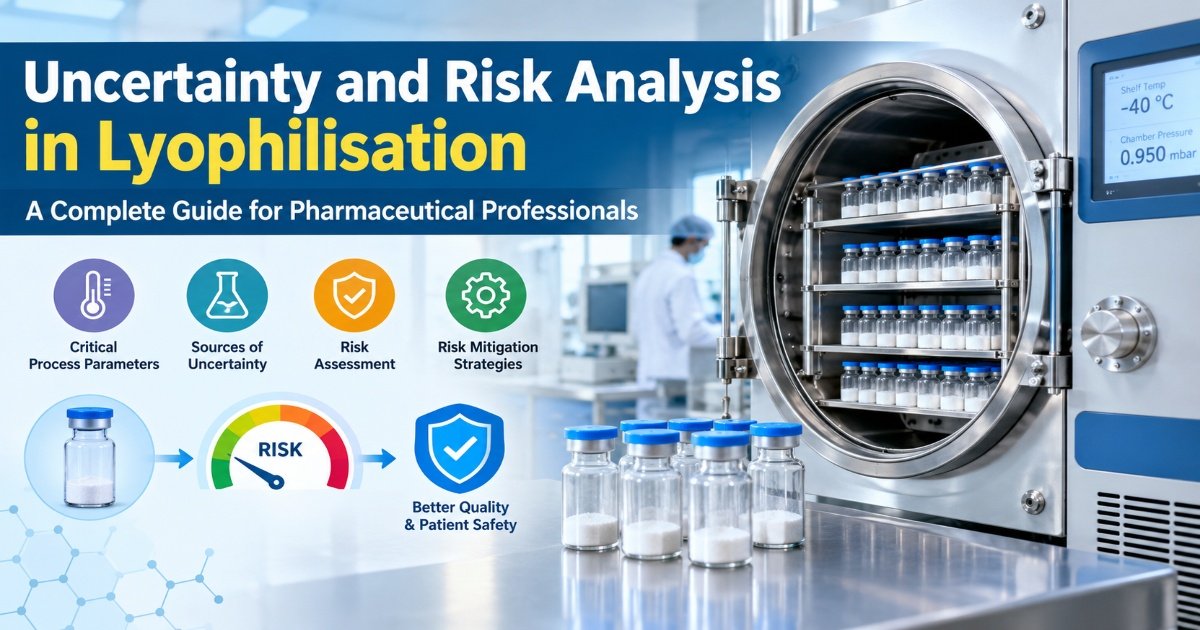
Uncertainty and Risk Analysis in Lyophilisation: A Complete Guide for Pharmaceutical Professionals
Lyophilization, also known as freeze-drying, is an important pharmaceutical manufacturing process. It helps improve the stability and shelf life of temperature-sensitive products, including vaccines, biologics, and injectable medicines. However, uncertainty and risk analysis in lyophilization is essential for maintaining product quality, process reliability, and patient safety.
Small changes in shelf temperature, chamber pressure, product formulation, or freezing conditions can affect the final product. These changes may lead to incomplete drying, collapse, excessive residual moisture, or reduced product stability.
A systematic risk analysis helps pharmaceutical manufacturers identify potential problems before they affect product quality. It also supports process development, technology transfer, process validation, and continued process verification.
In this guide, we will explore the major sources of uncertainty, risk assessment methods, critical process parameters, and practical strategies for improving lyophilization performance.
What Is Uncertainty and Risk Analysis in Lyophilization?
Uncertainty and risk analysis in lyophilization is a structured approach to identifying, evaluating, and controlling unknown factors and potential failures during the freeze-drying process.
Uncertainty refers to limited knowledge, variability, or incomplete information about a process or its results. Risk considers the possibility of harm and the potential impact of that harm.
In pharmaceutical freeze-drying, uncertainty may occur because of:
- Variations in formulation composition.
- Differences in vial size and fill volume.
- Changes in freezing rate.
- Inaccurate temperature measurements.
- Variability in chamber pressure.
- Differences in equipment performance.
- Limited understanding of product behaviour.
Risk analysis helps determine which uncertainties require investigation, monitoring, or control.
Difference Between Uncertainty and Risk
|
Factor |
Uncertainty |
Risk |
|---|---|---|
|
Meaning |
Lack of complete knowledge or predictable variation |
Potential for an undesirable outcome |
|
Example |
Unknown effect of a freezing rate on product structure |
Product collapse during primary drying |
|
Main focus |
Understanding variability |
Preventing or reducing harm |
|
Control method |
Studies, data collection, characterization |
Mitigation, monitoring, and validation |
A strong pharmaceutical quality system considers both uncertainty and risk during the entire product lifecycle.
Why Is Risk Analysis Important in Pharmaceutical Lyophilization?
Freeze-drying involves multiple interconnected stages. A problem during freezing can affect primary drying, while an unsuitable secondary drying temperature may damage the product.
Risk analysis provides several important benefits.
1. Improved Product Quality
Risk-based process understanding helps manufacturers protect critical quality attributes (CQAs), such as:
- Residual moisture.
- Cake appearance.
- Reconstitution time.
- Product potency.
- Sterility assurance.
- Biological activity.
2. Better Process Control
Identifying critical process parameters (CPPs) allows operators and engineers to focus on the variables that have the greatest influence on product quality.
3. Reduced Batch Failures
Early identification of potential failure modes can reduce the risk of collapsed cakes, incomplete drying, and extended processing times.
4. Support for Regulatory Compliance
Risk management supports pharmaceutical quality systems and aligns with principles described in ICH Q9(R1), which addresses quality risk management.
5. More Reliable Technology Transfer
Risk analysis helps identify differences between development equipment and commercial-scale freeze dryers. These differences may influence heat transfer, mass transfer, and drying performance.
Major Sources of Uncertainty in Lyophilization
Understanding the sources of uncertainty is the first step in developing a reliable freeze-drying process.


1. Formulation Variability
The formulation directly affects freezing behavior, ice crystal formation, product stability, and drying performance.
Variations in excipient concentration, active pharmaceutical ingredient (API), buffer composition, and solids content can change the product’s response during freeze-drying.
For example, two formulations with similar total solids may show different collapse temperatures and drying requirements.
Risk control measures:
Control raw material quality.
Define formulation composition limits.
Conduct formulation characterization.
Evaluate product thermal properties.
Monitor critical formulation attributes.
2. Freezing Rate Uncertainty
The freezing stage influences ice crystal structure and the resulting dried cake.
A rapid freezing rate may produce smaller ice crystals, while slower freezing can produce larger crystals under certain conditions. Ice crystal size affects the resistance to vapor flow during primary drying.
Potential risks include:
-
Poor mass transfer.
-
Increased drying time.
-
Cake structure variation.
-
Product instability.
-
Batch-to-batch differences.
Controlled nucleation, suitable shelf temperature profiles, and freezing studies can help reduce this uncertainty.
3. Equipment Variability
Commercial freeze dryers may show differences in heat transfer, chamber pressure control, condenser performance, and shelf temperature uniformity.
Factors include:
-
Shelf temperature distribution.
-
Vial position.
-
Chamber pressure measurement.
-
Condenser capacity.
-
Vacuum pump performance.
-
Stoppering system operation.
Equipment mapping and performance qualification help identify and control these variations.
4. Measurement Uncertainty
Process measurements are not perfectly exact. Sensors have calibration limits, resolution constraints, and response characteristics.
Important measurements include:
-
Product temperature.
-
Shelf temperature.
-
Chamber pressure.
-
Condenser temperature.
-
Vacuum system performance.
For example, a pressure sensor may report a stable chamber pressure while local vapor flow and product behavior vary. Therefore, pressure readings should be interpreted alongside other process information.
Critical Quality Attributes in Lyophilization Risk Analysis
Critical quality attributes are physical, chemical, biological, or microbiological characteristics that should remain within appropriate limits to ensure product quality.
The relevant CQAs depend on the formulation and dosage form.

Cake Appearance
Collapse, shrinkage, meltback, and structural defects may indicate process or formulation issues.

Residual Moisture
Excessive or insufficient moisture can affect stability and product performance.

Potency and Biological Activity
Temperature exposure and formulation conditions may affect sensitive biological products.
Common CQAs and Associated Risks
|
Critical quality attribute |
Potential risk |
|---|---|
|
Residual moisture |
Reduced stability or degradation |
|
Cake appearance |
Collapse, shrinkage, or poor structure |
|
Reconstitution time |
Delayed or incomplete dissolution |
|
Potency |
Loss of active ingredient activity |
|
Sterility |
Microbial contamination risk |
|
Particle characteristics |
Product quality or safety concerns |
Not every attribute applies equally to every product. Acceptance criteria should be scientifically justified and established for the specific product.
Critical Process Parameters (CPPs) and Their Risks
Critical process parameters are process variables whose variability can affect critical quality attributes.
1. Shelf Temperature
Shelf temperature controls the thermal energy supplied to the product.
During primary drying, excessive product temperature can increase the risk of cake collapse or loss of structure. A very low shelf temperature may extend the drying cycle.
Risk: Product temperature exceeds an acceptable limit.
Control strategy:
-
Develop a suitable shelf temperature profile.
-
Monitor product temperature where appropriate.
-
Establish safe operating limits.
-
Evaluate heat transfer during scale-up.
2. Chamber Pressure
Chamber pressure affects the vapor pressure gradient and drying conditions.
A pressure that is too high or unstable may affect drying efficiency. However, the appropriate pressure depends on product characteristics and equipment configuration.
Risk: Inadequate control of the primary drying environment.
Control strategy:
-
Verify pressure sensor calibration.
-
Monitor pressure stability.
-
Assess pressure control system performance.
-
Investigate unexpected pressure deviations.
3. Condenser Temperature
The condenser captures water vapor removed from the product during drying.
Insufficient condenser performance may reduce vapor capture capacity and influence system operation.
Risk: Reduced condenser capacity or unsuitable operating conditions.
Control strategy:
-
Verify condenser cooling performance.
-
Monitor condenser temperature.
-
Check refrigeration system functionality.
-
Establish appropriate operating limits.
4. Freezing Temperature and Time
Freezing conditions influence ice formation and product structure.
Risk: Inconsistent freezing behavior across batches or vial locations.
Control strategy:
-
Characterize freezing behavior.
-
Assess nucleation conditions.
-
Control the freezing profile.
-
Evaluate temperature uniformity.
5. Secondary Drying Temperature
Secondary drying removes water that remains after ice sublimation.
Excessive temperature or prolonged exposure may affect sensitive products, while insufficient drying may leave unacceptable moisture levels.
Risk: Product degradation or inappropriate residual moisture.
Control strategy:
-
Establish a validated secondary drying profile.
-
Evaluate product thermal stability.
-
Monitor the process according to the validated control strategy.
-
Confirm residual moisture through appropriate testing.
Risk Assessment Methods Used in Lyophilization
Pharmaceutical manufacturers use structured quality risk management tools to identify and evaluate process risks.
Failure Mode and Effects Analysis (FMEA)
FMEA is a systematic method for identifying potential failure modes, their effects, causes, and controls.
A typical FMEA considers:
-
Severity (S): Impact of the failure.
-
Occurrence (O): Likelihood of the failure.
-
Detectability (D): Ability to detect the failure before it causes harm.
A risk priority number (RPN) is sometimes calculated as:
Important: RPN scoring is a tool, not a universal regulatory requirement. Its use and thresholds should be defined by the organization’s risk management procedure.
Example: Lyophilization FMEA
|
Failure mode |
Possible effect |
Potential cause |
Risk control |
|---|---|---|---|
|
Product collapse |
Poor cake structure |
Excessive product temperature |
Thermal characterization and validated cycle |
|
Incomplete drying |
High residual moisture |
Insufficient primary drying |
Process development and endpoint assessment |
|
Pressure deviation |
Altered drying conditions |
Control system malfunction |
Sensor verification and investigation |
|
Uneven freezing |
Batch variability |
Heat transfer differences |
Freezing studies and equipment mapping |
|
Excessive secondary drying |
Product degradation |
Inappropriate temperature or time |
Stability studies and validated processes |
A practical FMEA should use product-specific data rather than generic assumptions.
Uncertainty During Primary Drying
Primary drying is often one of the most sensitive stages of the lyophilization cycle. Ice is removed through sublimation under reduced pressure.
The process depends on the relationship between:
-
Product temperature.
-
Shelf temperature.
-
Chamber pressure.
-
Heat transfer.
-
Mass transfer.
-
Ice resistance.
-
Product resistance.
Product Temperature and Collapse Risk
The product temperature should remain within a suitable range based on its formulation and thermal characteristics.
For amorphous products, the collapse temperature is an important consideration. For crystalline systems, other thermal and structural limitations may be relevant.
A simplified risk relationship is:
Here, TpT_p represents product temperature, and TcriticalT represents a scientifically established temperature limit for the relevant product condition.
This is a conceptual relationship, not a universal operating limit. Actual process limits require product-specific studies.
How to Reduce Primary Drying Uncertainty
-
Determine relevant thermal characteristics.
-
Develop an appropriate shelf temperature profile.
-
Study heat and mass transfer.
-
Evaluate product temperature at representative locations.
-
Confirm drying endpoint using suitable evidence.
-
Review batch trends during continued process verification.
Uncertainty During Secondary Drying
Secondary drying focuses on removing water that remains after primary drying.
The amount of water removed depends on product formulation, temperature, time, and other process conditions.
Potential risks include:
-
Excessive residual moisture.
-
Product degradation.
-
Loss of biological activity.
-
Extended cycle time.
-
Batch-to-batch variability.
A suitable secondary drying cycle balances the need for moisture reduction with the stability requirements of the product.
Risk-Based Secondary Drying Strategy
A manufacturer should evaluate:
-
Product sensitivity to temperature.
-
Moisture content after primary drying.
-
Target residual moisture range.
-
Stability data.
-
Drying time and temperature.
-
Equipment and load configuration.
Residual moisture acceptance limits must be established based on product quality and stability requirements rather than applying one limit to all products.
Role of Design of Experiments (DoE)
Design of Experiments is a structured statistical approach for studying how process variables influence product outcomes.
In lyophilization, DoE can help evaluate interactions between:
-
Shelf temperature.
-
Chamber pressure.
-
Freezing rate.
-
Fill volume.
-
Formulation composition.
-
Primary drying duration.
Example of a Lyophilization DoE
|
Factor |
Low condition |
High condition |
|---|---|---|
|
Shelf temperature |
Development-defined low level |
Development-defined high level |
|
Chamber pressure |
Development-defined low level |
Development-defined high level |
|
Freezing rate |
Slow profile |
Fast profile |
|
Primary drying time |
Shorter duration |
Longer duration |
The actual levels should be selected using scientific knowledge, equipment capability, and product-specific constraints.
DoE results may help identify process interactions and support the development of a design space where appropriate.
Use of Process Analytical Technology (PAT)
Process Analytical Technology (PAT) supports process understanding through timely measurement and analysis of critical process information.


PAT approaches may include:
-
Product temperature measurement.
-
Pressure monitoring.
-
Pirani and capacitance manometer comparison.
-
Tunable diode laser absorption spectroscopy (TDLAS).
-
Near-infrared spectroscopy (NIRS), where suitable.
-
Heat flux measurement.
-
Advanced process data analysis.
How PAT Reduces Uncertainty
PAT can provide information about process behavior that may not be evident from fixed cycle settings alone.
For example, pressure measurements from different sensor technologies may offer complementary information during primary drying. Their interpretation requires an understanding of sensor characteristics and process conditions.
PAT implementation should be based on the product, process, measurement performance, and intended use.
Risk Analysis of Freeze Dryer Equipment
Equipment-related risks can affect both process consistency and product quality.
Vacuum System Risks
Potential issues include:
-
Vacuum pump performance degradation.
-
Leakage in the chamber or connected piping.
-
Incorrect pressure sensor readings.
-
Valve malfunction.
-
Unstable pressure control.
Mitigation:
-
Perform leak testing according to established procedures.
-
Maintain vacuum equipment.
-
Verify sensor calibration.
-
Investigate pressure deviations.
-
Follow approved preventive maintenance schedules.
Refrigeration and Condenser Risks
Potential issues include:
-
Inadequate condenser cooling.
-
Refrigeration system malfunction.
-
Excessive ice accumulation.
-
Unexpected temperature deviations.
Mitigation:
-
Verify refrigeration performance.
-
Monitor condenser temperature.
-
Perform maintenance and qualification activities.
-
Assess equipment alarms and interlocks.
Shelf Heating and Cooling Risks
Shelf temperature control affects the freezing and drying stages.
Potential problems include:
-
Nonuniform shelf temperature.
-
Slow temperature ramping.
-
Sensor error.
-
Heat transfer variability.
-
Hydraulic system issues.
Qualification, mapping, maintenance, and alarm management are important elements of risk control.
Human Error and Operational Risk
Not all lyophilization risks originate from equipment or formulation. Human factors can also influence process performance.
Examples include:
-
Incorrect recipe selection.
-
Incorrect loading configuration.
-
Improper equipment setup.
-
Inadequate review of alarms.
-
Failure to follow approved procedures.
-
Incorrect interpretation of process data.
Risk Reduction Measures
-
Train operators on the approved procedure.
-
Use appropriate access controls and recipe management.
-
Verify critical settings before cycle initiation.
-
Maintain clear batch documentation.
-
Investigate deviations using documented procedures.
-
Review operator training effectiveness.
Human error investigations should focus on contributing factors and system improvements rather than automatically assigning blame to individuals.
Risk-Based Approach to Process Validation
Process validation demonstrates that a process can consistently deliver a product meeting predetermined quality requirements.
A risk-based validation strategy generally considers the relationship between process parameters, equipment, product attributes, and the intended manufacturing scale.
Key Validation Activities
1. Process Design
Develop process knowledge through formulation studies, thermal characterization, and equipment understanding.
2. Process Qualification
Demonstrate that the equipment and process can operate as intended under defined conditions.
3. Continued Process Verification
Monitor process performance and relevant quality information during routine production.
Risk assessment should be updated when new knowledge, significant deviations, equipment changes, or process modifications occur.
Digital Twins and AI for Lyophilization Risk Analysis
Digital twins and AI-based process models are emerging approaches for improving process understanding and monitoring.
A digital twin may combine equipment data, process models, and historical information to support simulation or operational decision-making.
Potential applications include:
-
Predicting drying behavior.
-
Identifying abnormal process trends.
-
Supporting cycle development.
-
Evaluating equipment performance.
-
Detecting unusual temperature or pressure patterns.
However, model predictions contain uncertainty. AI systems require suitable training data, validation, performance monitoring, and human oversight.
AI-generated predictions should not automatically replace qualified process controls or scientifically justified acceptance criteria.
Practical Risk Analysis Workflow
A structured workflow helps integrate uncertainty management into pharmaceutical freeze-drying operations.
-
Define the process and product
Identify the formulation, equipment, process stages, CQAs, and intended manufacturing conditions.
-
Identify uncertainties
Review formulation variability, equipment capability, measurement limitations, and scale-up differences.
-
Identify potential failure modes
Use FMEA, process mapping, or other appropriate quality risk management tools.
-
Evaluate the risks
Assess the severity, likelihood, detectability, and scientific evidence for each identified risk