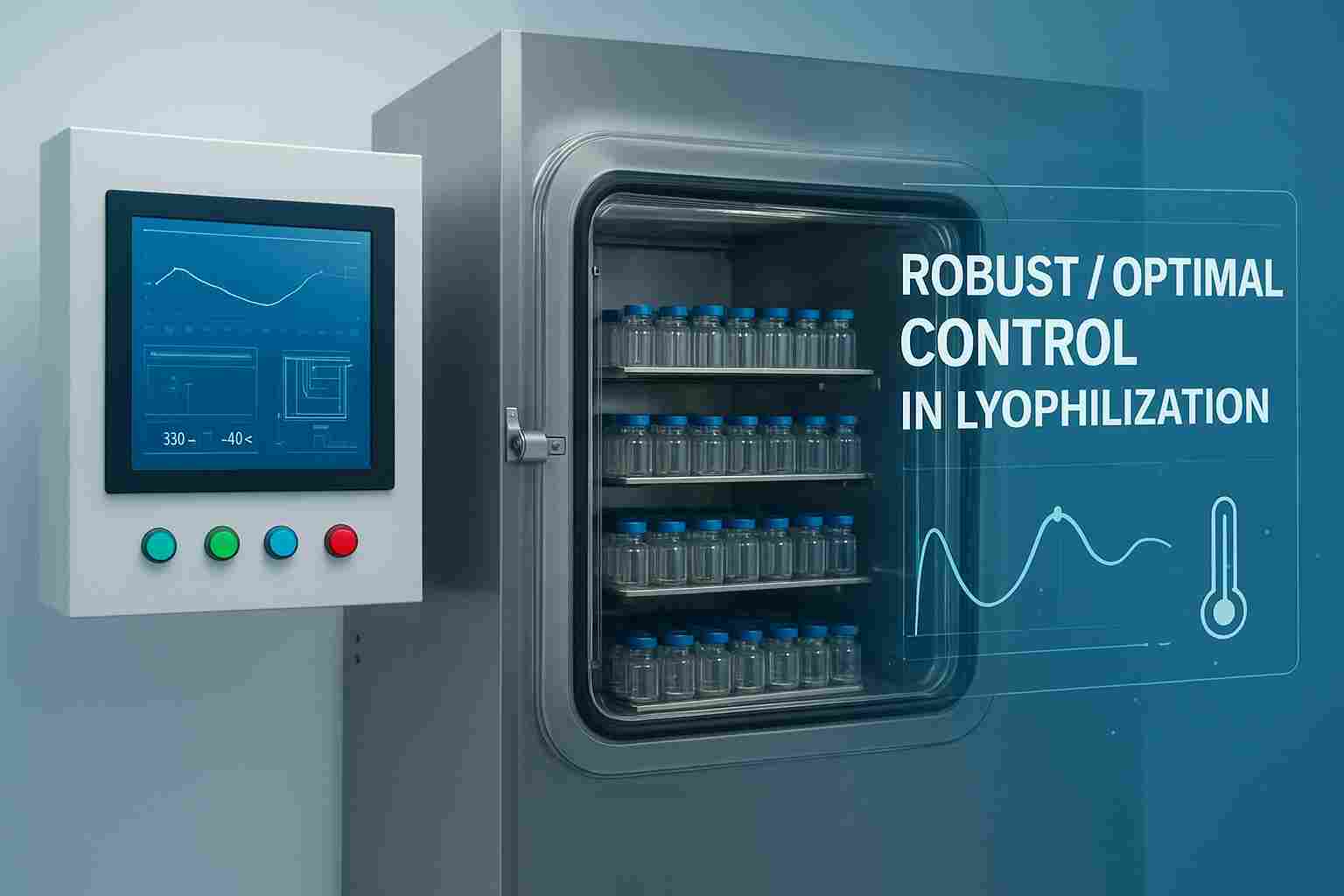
Robust/optimal control in lyophilization has become one of the most crucial advancements in modern freeze-drying cycle design. As pharmaceutical, biotech, and veterinary manufacturers demand higher precision, faster throughput, and consistent product quality, traditional “set-and-hold” control strategies no longer meet industry expectations. Therefore, scientists and engineers now rely on advanced differential-algebraic equations (DAEs), model predictive control (MPC), uncertainty analysis, and PAT-driven feedback loops to build optimal freeze-drying cycles.
Moreover, as intelligent systems like Lyophilization 4.0, AI-based monitoring, blockchain-integrated supply chains, and smart process analytics become highly common, robust control ensures reliability across every step of the freeze-drying lifecycle—from freezing to primary drying, secondary drying, and stoppering.
This article explains the science, engineering, technology, and real-world applications of robust and optimal control in lyophilization, while naturally integrating your internal links to provide readers with deeper knowledge.
What Is Robust/Optimal Control in Lyophilization?
“Robust control” refers to control algorithms designed to maintain performance even when uncertainties occur—such as variations in:
- Shelf heat transfer
- Chamber pressure
- Vial load
- Formulation properties
- Heat transfer coefficients
- Equipment performance
- Environmental conditions
On the other hand, optimal control aims to find the best possible cycle that meets all constraints while reducing time, energy, and risks—especially meltback, fogging, vial cracking, and product collapse.
Together, robust/optimal control in lyophilization creates freeze-drying cycles that are:
- Faster
- More energy-efficient
- More stable
- More repeatable
- Less vulnerable to failures
- Highly predictable under real-world conditions
Why Modern Freeze-Drying Requires Robust Control
Traditional lyophilization control uses fixed limits like:
- Shelf temperature
- Chamber pressure
- Ramp rates
However, modern products—mAbs, vaccines, peptide drugs, and cell & gene therapies—have tighter thermal and structural limits. Even a small temperature overshoot may damage product integrity. As explained in the guide on the impact of temperature overshoots during lyophilization, maintaining exact thermal stability is crucial.
Furthermore, emerging technologies like
- Lyophilization 4.0
- AI monitoring
- Continuous freeze-drying
- PAT systems
- Cryo-microscopy analysis
require smarter, adaptive control strategies.
Because of this, robust control ensures that the system performs correctly even when moisture content, cake resistance, or heat flux vary unpredictably.
How Robust/Optimal Control Works in Lyophilization
Below are the key mechanisms that govern robust and optimal control cycles.
Mathematical Modeling with Differential-Algebraic Equations
DAEs allow engineers to model:
- Heat transfer
- Mass transfer
- Sublimation front dynamics
- Dry layer resistance
- Chamber vapor flux
- Vial wall conduction
- Real-time ice sublimation rate
Reading more on dry layer resistance during primary drying provides additional insights into how moisture escape impacts heat transfer modeling.
DAE models help determine:
- Maximum safe shelf temperature
- Optimal chamber pressure
- Minimum drying time
- Maximum sublimation rate
- Critical collapse temperature
Thus, engineers can “pre-test” different cycles through simulations.
Uncertainty Analysis for Real-World Variability
Real lyophilization cycles face uncertainties such as:
- Variability in condenser efficiency
- Imperfect vacuum levels
- Fluctuating cooling water supply
- Uneven shelf temperatures
- Mechanical wear in compressors and pumps
Read more on cooling water regulation, vacuum chamber operation, and compressor performance failures to see why uncertainty analysis is essential.
Robust control algorithms simulate extremes like
- Sudden heat load changes
- Unexpected ramp-step extensions
- Shelf non-uniformities
- Intermittent vacuum drops
The system then adjusts cycle parameters to maintain product safety.
Model Predictive Control (MPC)
MPC uses live data to predict system behavior and adjust parameters proactively. It is widely used in:
- Industrial automation
- Aerospace
- Chemical plants
- High-speed robotics
In lyophilization, MPC adjusts:
- Shelf temperature
- Condenser load
- Pressure control valve settings
- Heating/cooling media flows
Read detailed article on heating media control in lyophilization and temperature control strategies.
PAT (Process Analytical Technology) Integration
PAT tools like
- NIR spectroscopy
- Mass spectrometry
- Moisture sensors
- Pirani + capacitance manometers
- Cryo-microscopy feedback
- AI-driven imaging
Ensure real-time monitoring.
PAT ensures that the system not only predicts behavior but also measures true product state:
- Ice content
- Moisture distribution
- Sublimation progress
- Cake structure
- Endpoint determination
Hence, control can be dynamic instead of fixed.
AI-Driven Cycle Optimization
AI can monitor:
- Shelf temperature rise
- Chamber pressure deviation
- Vial fogging
- Glass particle contamination
- Meltback tendencies
When AI detects abnormal patterns, it immediately adjusts shelf temperature or chamber pressure—before a defect forms.
Benefits of Implementing Robust/Optimal Control in Lyophilization
Reduced Cycle Time
The system always uses the highest safe shelf temperature and lowest pressure for maximum sublimation without collapse.
Consistent Product Quality
Pharmaceuticals, biopharmaceuticals, and vaccines maintain uniform structure across batches. Read more on lyophilized product quality, defect classification, and dose variation.
Lower Energy Consumption
Optimal control reduces condenser load, heating cycles, and compressor usage.
Read more about how energy efficiency in lyophilization aligns with this.
Minimizes Risk of Defects
Such as:
- Meltback
- Collapse
- Fogging
- Vacuum failures
- Sealing defects
Better Regulatory Compliance
Because cycles become:
- More controlled
- More documented
- More repeatable
- Easier to validate
This aligns with your guides on cGMP, validation, qualification, and regulatory compliance.
Real-World Applications of Robust/Optimal Control
Biopharmaceuticals: For peptides, mAbs, and vaccines—where collapse temperature is low. Applications of freeze-drying in biopharmaceuticals
Cell and Gene Therapy: Where product integrity is extremely sensitive to thermal variation.
Read more. freeze-drying for cell and gene therapy
Veterinary Drugs: Where freeze-drying large batches demands advanced control.
See: Lyophilization in veterinary drugs
Continuous Freeze-Drying Systems: Such systems require real-time adaptive control.
See: Continuous freeze-drying in pharmaceuticals
Blockchain-Integrated Supply Chain Monitoring
Robust control ensures reliable and tamper-proof records.
See: Blockchain in lyophilization supply chain
Key Components Required for Robust Control
- Highly accurate sensors
- Stable vacuum pumps
- Efficient condenser
- PID + MPC controllers
- Real-time PAT tools
- SCADA/PLC integration
- AI diagnostic systems
Read more about PLC failures, pressure sensors, vacuum pump failures, cooling system failures, and heating element failures to see how hardware reliability supports robust control.
Future Trends in Robust/Optimal Control for Freeze-Drying
- Digital Twins for Lyophilization: A digital replica predicts cycle behavior.
- Hybrid AI + MPC Systems: AI learns patterns; MPC handles mathematical prediction.
- Cloud-Based Monitoring and Cycle Optimization: Remote visibility enhances manufacturing intelligence.
- Real-Time Moisture Mapping: With 3D analysis tools.
FAQs—Robust/Optimal Control in Lyophilization
What is robust control in lyophilization?
It is a method that maintains cycle stability even under uncertainty in temperature, pressure, or heat transfer.
Why is optimal control important?
It minimizes cycle time while preventing product collapse or meltback.
How does MPC improve freeze-drying?
MPC predicts future system behavior and adjusts shelf temperature and pressure proactively.
Can robust control reduce cycle failure?
Yes, because it compensates for fluctuations in equipment and environmental conditions.
Does robust control help with energy savings?
Absolutely. It optimizes heat load and condenser performance to reduce energy usage.
Is PAT necessary for robust control?
Yes, because PAT provides real-time measurement of product conditions.
How does AI support robust lyophilization control?
AI detects early patterns of deviation and adjusts control actions automatically.
Is robust control suitable for all formulations?
Yes, especially for biologics, vaccines, and heat-sensitive drugs.
Can robust control be used in continuous freeze-drying?
Definitely. Continuous systems depend heavily on adaptive control.
Does robust control simplify regulatory compliance?
Yes, because it produces more consistent and fully documented cycles.