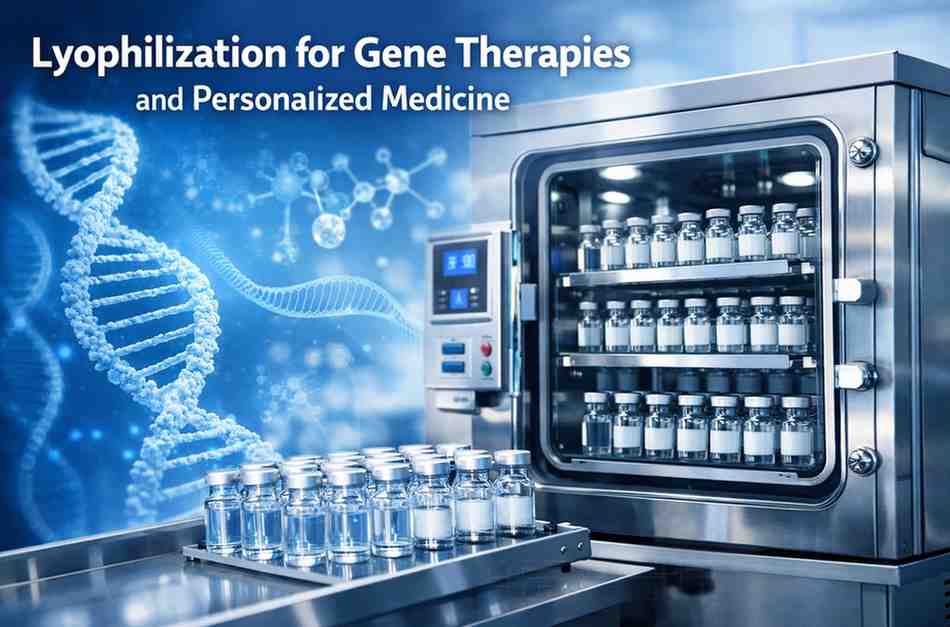
Lyophilization for Gene Therapies and Personalized Medicine: Advanced Freeze-Drying Strategies for Next-Generation Biologics
Lyophilization for Gene Therapies and Personalized Medicine has become a critical enabler in the rapidly evolving field of advanced biologics. As gene therapies, cell-based products, and personalized medicines move from experimental pipelines to commercial reality, manufacturers face unprecedented challenges related to stability, shelf life, transport, and patient-specific dosing. Freeze-drying, also known as lyophilization, offers a proven and adaptable solution to these challenges.
Unlike traditional pharmaceuticals, gene therapies and personalized biologics often involve highly sensitive materials such as viral vectors, plasmid DNA, mRNA, oligonucleotides, and complex protein systems. These materials degrade quickly in liquid form and demand precise environmental control. Therefore, tailored lyophilization processes are no longer optional; instead, they are essential for product success.
This article explores how lyophilization supports gene therapies and personalized medicine, explains the scientific and engineering principles behind customized freeze-drying cycles, and highlights best practices, regulatory considerations, and future trends shaping this fast-growing market.
Understanding Lyophilization in Advanced Biologics
Lyophilization is a dehydration process that removes water from frozen products through sublimation under vacuum. This method preserves molecular structure, biological activity, and formulation integrity far better than conventional drying techniques.
In the context of gene therapies and personalized medicine, lyophilization plays a vital role in:
- Enhancing long-term stability of fragile genetic materials
- Enabling storage at refrigerated or room temperatures
- Supporting global distribution without ultra-cold logistics
- Maintaining potency throughout the product lifecycle
To understand the broader fundamentals of this technology, readers may refer to the comprehensive overview at https://asitafreezedryer.com/what-is-lyophilization-technology/.
Why Gene Therapies Require Specialized Lyophilization
Gene therapy products differ significantly from conventional biologics. They often involve living systems or genetically active components that react sensitively to heat, moisture, shear stress, and oxygen exposure. Consequently, standard freeze-drying cycles rarely deliver optimal results.
Key Sensitivities of Gene Therapy Products
- Thermal sensitivity: Even small temperature deviations can reduce transfection efficiency.
- Moisture sensitivity: Residual moisture can trigger hydrolysis or aggregation.
- Shear sensitivity: Mechanical stress during freezing can damage viral capsids.
Because of these vulnerabilities, lyophilization for gene therapies must be highly controlled and product-specific. Manufacturers increasingly rely on advanced process monitoring and optimized control parameters, as discussed in https://asitafreezedryer.com/optimizing-control-parameters-in-freeze-drying-process/.
Personalized Medicine and the Need for Custom Freeze-Drying
Personalized medicine focuses on tailoring therapies to individual patients or small patient populations. This approach changes traditional manufacturing economics and introduces new complexity in freeze-drying operations.
Challenges Unique to Personalized Medicine
- Small batch sizes or single-patient doses
- Rapid turnaround times
- Variable formulations across patients
- Limited material availability for development
Lyophilization for personalized medicine must therefore be flexible, scalable, and reproducible. Modular freeze dryers, single-use containers, and adaptable cycle designs are increasingly preferred in this space.
For a deeper look at freeze-drying equipment fundamentals, see https://asitafreezedryer.com/freeze-drying-equipment-components-and-functions.
Formulation Development for Lyophilized Gene Therapies
Formulation design directly determines the success of lyophilization for gene therapies and personalized medicine. Each excipient must protect the active ingredient during freezing, drying, and storage.
Common Excipients Used
- Cryoprotectants such as sucrose and trehalose
- Bulking agents like mannitol or glycine
- Buffers to maintain pH stability
- Surfactants to reduce surface-induced stress
The selection and concentration of these excipients influence critical parameters such as glass transition temperature, collapse temperature, and residual moisture limits. Understanding eutectic and critical temperatures is essential, as explained in https://asitafreezedryer.com/eutectic-temperature-in-lyophilization-understanding-the-critical-point.
Freezing Strategies for Genetic Materials
Freezing is the first and often most impactful step in lyophilization. Poor freezing can cause phase separation, concentration gradients, and structural damage.
Controlled Freezing Approaches
- Slow freezing to reduce intracellular stress
- Annealing to improve ice crystal uniformity
- Directional freezing for enhanced mass transfer
Advanced freezing techniques improve primary drying efficiency and reduce dry layer resistance, which is a known bottleneck in lyophilization processes. For additional insight into process characteristics, visit https://asitafreezedryer.com/characteristics-of-the-freeze-drying-process.
Primary Drying Optimization for Gene Therapies
Primary drying removes frozen water through sublimation. This stage requires precise control of shelf temperature and chamber pressure.
Key Optimization Goals
- Preventing product collapse
- Minimizing drying time
- Preserving biological activity
Real-time pressure and temperature monitoring tools, including Pirani and capacitance manometers, are essential for accurate control. Issues related to sensor reliability are discussed at https://asitafreezedryer.com/failure-of-an-active-mks-or-pirani-pressure-sensor-in-freeze-dryer/.
Secondary Drying and Residual Moisture Control
Secondary drying removes bound water molecules and determines long-term stability. Gene therapy products often require extremely low residual moisture levels.
Best Practices
- Gradual temperature ramping
- Extended drying times for dense formulations
- Validation of moisture endpoints
Excessive heat exposure must be avoided, as it may denature proteins or degrade nucleic acids. Temperature-related failures are addressed in heat-exchanger-heater-excess-temperature-during-freeze-drying/.
Container Closure Systems for Personalized Biologics
The choice of vials, stoppers, and containers significantly affects lyophilization outcomes. Personalized medicine often uses non-standard container formats.
Key Considerations
- Container geometry and heat transfer efficiency
- Stoppering under vacuum or inert gas
- Compatibility with automated filling systems
Learn more about lyophilized vials and their importance at lyophilized-vials-essential-for-research-medicine
Regulatory Expectations and Quality by Design
Regulatory agencies expect a strong scientific rationale for lyophilization processes used in gene therapies and personalized medicine.
Focus Areas
- Process understanding and control
- Risk assessment and mitigation
- Validation and continued process verification
Quality by Design principles help manufacturers define design space and ensure consistent product quality. Guidance on lyophilizer qualification is available at lyophilizer-qualification-ensuring-freeze-dryer-quality
Process Analytical Technology (PAT) in Lyophilization
PAT tools enable real-time monitoring and control, which is especially valuable for small-batch personalized therapies.
Common PAT Tools
- Tunable diode laser absorption spectroscopy (TDLAS)
- Mass spectrometry for leak detection
- Wireless temperature probes
Advanced monitoring improves robustness and reduces batch failures, aligning with modern regulatory expectations.
Scaling from Clinical to Commercial Manufacturing
Scaling lyophilization for gene therapies involves more than increasing batch size. Instead, manufacturers must preserve product quality while adapting to new equipment and throughput demands.
Key Scaling Strategies
- Geometric and thermal similarity
- Use of scalable cycle parameters
- Data-driven process transfer
Operational challenges during scale-up are covered in lyophilization-troubleshooting-a-comprehensive-guide
Sustainability and Energy Efficiency Considerations
As production volumes increase, energy efficiency becomes critical. Optimized lyophilization cycles reduce environmental impact and operating costs.
Strategies include:
- Shortened primary drying times
- Improved heat transfer efficiency
- Smart control systems and automation
Future Trends in Lyophilization for Personalized Medicine
The future of lyophilization for gene therapies and personalized medicine will be shaped by innovation and digitalization.
Emerging Trends
- AI-driven cycle optimization
- Digital twins for process simulation
- Continuous and semi-continuous freeze-drying
Smart lyophilizers integrating IoT technologies will further enhance reliability and flexibility.
Conclusion
Lyophilization for Gene Therapies and Personalized Medicine is no longer a niche application; instead, it is a foundational technology enabling the safe, effective, and scalable delivery of next-generation biologics. Through customized formulations, precise process control, and advanced monitoring, freeze-drying addresses the unique challenges posed by genetic materials and patient-specific therapies.
As the gene therapy and personalized medicine markets continue to grow, tailored lyophilization strategies will remain essential for ensuring product stability, regulatory compliance, and patient safety.
Frequently Asked Questions (FAQs)
Why is lyophilization important for gene therapies?
Lyophilization improves stability, extends shelf life, and protects sensitive genetic materials from degradation.